Editing vs. Proofreading
Editing and proofreading are distinct and ought not be confused.
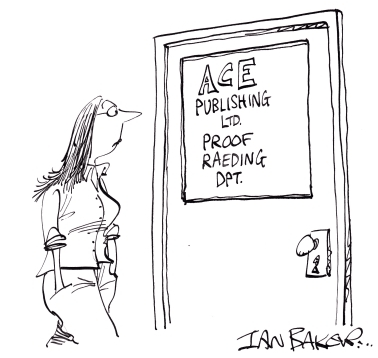
Proofreading is purely technical. It consists of checking for spelling, grammatical, and formatting mistakes, obvious factual errors, and problems with typesetting and page layout. Proofreading is meant to be the last set of eyes on a manuscript before publication, often in page proofs, to make sure that all edits were entered correctly and that no new errors were introduced during editing. A proofreader makes only minor, absolutely necessary adjustments—nothing in the broader realm of language, usage, or style, which are reserved for the editing stage. Proofreading is only appropriate once your content is complete and you’re confident that your language is as effective as it can be.
All manuscripts should be proofread; nasty little errors have a way of sneaking in, and all too often, authors and even editors are just too close to the text at that point to catch them.
Editing is more of an art. It takes place before typesetting, often before a manuscript reaches the publisher. There are three different levels within the realm of editing: copyediting, content editing, and developmental editing.
Copyediting is the process of perfecting a finished manuscript—tightening up language and addressing grammar, syntax, usage, spelling, punctuation, capitalization, and style. Copyeditors also check cross-references for consistency, query possible factual errors, and address formatting issues like headers and footers, headings and subheads, citations, and the like. A seasoned editor will compile a style sheet to ensure consistency throughout the manuscript.

Content editing goes beyond copyediting to take a more in-depth look at a manuscript. It addresses clarity, flow, and cohesiveness to hone the argument, analysis, or narrative, addressing idiomatic language, awkward phrasing, ambiguity, and so on. Often there is some rewording or rewriting and reorganizing of the text, all done in close coordination with the author. An adept editor will be careful to stay true to the writer’s voice, tone, and meaning. Although fact-checking is not generally in the editor’s purview, a keen editor will also query any details that seem inaccurate or incongruous.
The terms content editor, substantive editor, line editor, and developmental editor are often used interchangeably for editing at a more comprehensive level than copyediting. The first three terms are analogous; developmental editing is an entirely different animal, in which the author and editor work closely together to develop a book or other project from the initial concept onward. Developmental editing entails studying existing works from a comparative perspective and assessing a book’s high-level structure and organization, chapter-to-chapter development, and end-to-end logic. It does not address the above-described editorial elements of language, syntax, and style, and semantics. I do not offer developmental editing.
I tell this to all my clients: you’ll do yourself a favor to submit the most final, polished version of your work; otherwise you’ll end up spending extra time (and money) going back-and-forth with your editor. If you’re not sure what your manuscript needs, ask! I offer all my potential clients a complimentary half-hour phone call to discuss their projects and ask any questions. I want you to feel comfortable with me and my process, and confident that you’re getting exactly what you need.
 Ellipses Editing